Where it is
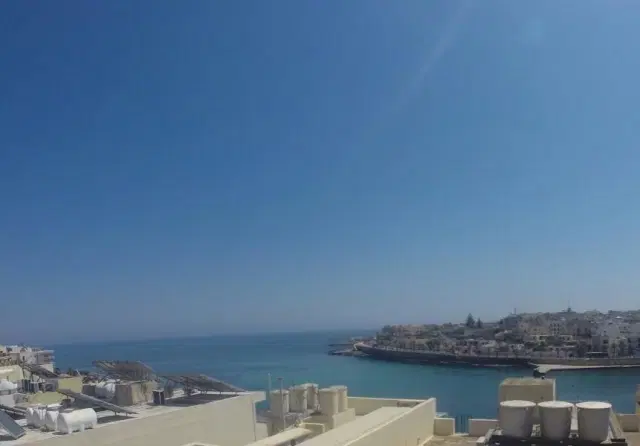
Marsaskala, also known as Wied il-Għajn, is a seaside town in the Southern Region of Malta. The town surrounds Marsaskala Bay, a long, narrow inlet. Ras iż-Żonqor shelters the bay to the north, while Ras il-Gżira lies to the south. The town extends along both sides of the bay and around Il-Ħamrija, a creek leading towards Il-Ponta tal-Gżira.
The original village was in the area of San Gwakkin and Santa Tereza, on the road to Żabbar. Today, the urban area extends north towards Żonqor and across the hilly peninsula of San Tumas. Bellavista and Wied il-Għajn lie on the hills southwest of the parish church. The town is surrounded by countryside, with fields around San Tumas Bay. Il-Magħluq, a natural reserve, is near the centre of town, and the northern countryside forms part of Il-Park Nazzjonali tal-Inwadar.
History and growth
Archaeological finds indicate that people have inhabited the area since prehistory. These include cart-ruts, parallel channels formed in the rock. Early Christian catacombs and Roman remains have also been found. The Roman remains suggest that Marsaskala may have served as a port in that period. Four Roman ship anchors found in the bay during the 1960s are now at the Malta Maritime Museum.
In 1614, Ottoman ships landed at Marsaskala and attacked the south of Malta. Coastal defences were built in later centuries, including Saint Thomas Tower, Żonqor Tower and the Briconet Redoubt. Saint Thomas Tower dates to 1565, the Briconet Redoubt to 1715, and the British built Żonqor Battery in 1882. Żonqor Tower was demolished in 1915.
Marsaskala was a fishing village in the early 1900s, with agriculture and fishing among its traditional activities. It has since grown into a major urban centre in Malta's southeast. Residential development has spread across San Tumas, the Bellavista hillside and the Zonqor coastline. The town's first local council was formed in 1994.
Population and daily life
Marsaskala had a population of 16,804 in the 2021 census. In summer, the population rises to over 20,000. The town has also become a residential area for people who commute to work elsewhere on the island. Tourism has grown in importance since Malta's independence, particularly after the Jerma Palace Hotel opened in the 1980s. The hotel closed in March 2007.
The town has a primary school in the area behind the parish church. St Anne Primary hosts 500 pupils. St Joachim Primary opened in 2019 to serve pupils from the San Tumas area and caters to 300 pupils. Both schools are affiliated with St Thomas More College in Żejtun. The Marsaskala Branch Library is within St Anne Primary.
Churches and open spaces
Marsaskala's parish church is dedicated to Saint Anne and was built in 1953. A smaller, older church dedicated to Saint Anne stands nearby, among the houses of the old village. The parish feast is celebrated at the end of July. Other chapels include the Chapel of Our Lady of the Girdle and the Baroque Chapel of Our Lady of the Rosary at Villa Apap-Bologna. Chapels dedicated to Saint Nicholas, Saint Gaetan, Saint Anthony of Padua and the Madonna of Light are found in the countryside.
Sant'Antnin Family Park opened in 2013 and covers 85,000 square metres. Il-Magħluq is a natural reserve in the centre of town. The coastline north from Żonqor towards Xgħajra is part of Il-Park Nazzjonali tal-Inwadar.
Sport and connections
Football and waterpolo are among the main sports in Marsaskala. Marsaskala F.C. was founded in 2010. Marsaskala Sports Club, founded in 1927 and re-founded in 1974, is a waterpolo club. The club won the Malta championship in 1997, the only time the trophy was won by a club from southern Malta. The town is also popular with divers and swimmers.
The bus terminal has Tallinja services connecting Marsaskala with Valletta via Żabbar and with L-Isla. Another service connects the town to the airport.